








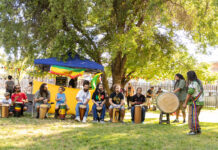





– eight musicians, led by Manuel Araya on vocals and guitar Matthias Malinarich, give life to this group that mixes Reggae with Latin and African-American rhythms, fusion that they themselves have called Latin / Rock / Reggae.
An unexpected October rain floods the avenues of Santiago. At times, Copiapó street becomes impassable. Its narrow paths become real streams, hindering the walk of its wanderers.. It is there - on that street where only the colors of each facade distinguish one house from the other- in a rehearsal room, the meeting place with the national band “Football".
While we were walking, We reflect on some aspects of the history of this already historic Chilean Reggae band. We remembered, for example, those gigs back in the year 99, when Reggae mobilized entire days of live music, of big bands on family afternoons, Ganjah, and love for art. The year in which “Kitra” – which in Mapudungun means Pipe- debuted at a punk festival in the town of Nuevo Amanecer, in the commune of the Florida.
Felipe, the sax man, welcomes us at the door. The reunited band reviews the raw material from their recent performance at the Rototom Sunplash Festival, in Spain.
Already installed and with an intermittent rain in the background, We talked about his career, experiences and future projects. little by little, los “football” they take us on a journey through the most important milestones of their career. We talk about the Reggae scene in Chile and the stones they have had to avoid on this long road, to mention some aspects of this journey that we share with you, interview carried out by Reggae Chalice.
“An important moment for us was playing at Mapocho Station next to Gondwana. They were at their best and the station was packed. “That was our first big recital.”, remembers Matías Malinarich, bassist and founder of the band, about the day they opened for Gondwana for the release of the album “Made in Jamaica”, in the year 2002.
Diego Mardones -drummer of the group-, he quickly complements the answer and adds “I think that the tours to the south. The tours happened at a time when the group was in the doldrums., then it came as a surprise to us. First time we won a FONDART and those tours reactivated the band, "he revived us".
In the summer of 2014 and during 20 days , the band performed – for the first time- a tour of various cities in the south of the country under the name of the “Lo Justo” tour, a series of free events in communes of the VIII, IX, X and XIV regions.
About this arduous and beautiful experience lived, the percussionist football, also known as Mr. Quickman, He states that “it was a super intense experience.”. Three weeks traveling, first time we did it together as a group. “It was knowledge.”.
The earthquake that affected the southern part of the country in February 2010 It was undoubtedly another milestone that marked his career.. “We were playing in Concepción, We had just gotten off the stage when the shit was left”, remember.
For Manuel Araya, vocalist and founder of the group, An important event in the history of the band was their presentation at the Santiago Penitentiary, under the framework of the “Population Tour”.
“No one caught us”, they comment, “they are all repressed, the music can be loud and they don't move a muscle. The atmosphere is harsh (…) There we ran into people from the Manuel Rodríguez Patriotic Front and the Lautaro, who were the oldest prisoners. When we played the song “Araucanía” they approached us, They supported us and gave us all the good vibes for what we did and the speech we proposed in our topics.. Feeling that reception was very gratifying”, Manuel and Matías remember.
Life is sweet and pleasant. For football, in this long journey of now 16 years of uninterrupted activity on the national scene - which includes two studio albums (“We are Many” in 2008 and “The Just” in 2013) and two national tours-, They have had intense ups and downs.
“We make music in a shitty environment. There is no space here to make music, Reggae is not a genre, That's why there came a tense moment of not knowing where we could play.", remembers Manu and adds “there came a time when we simply had nowhere to play.”.
“Musically we were weak. The tour strengthened us as a band and also on a musical level.. The 2014 We left it with a different vibe”, says Diego.
Matías reaffirms the premise and assures that, except exceptions, You can't make a living from music in Chile. “The bands that have achieved it go on tour, because there is no Reggae music circuit here. In fact, Reggae has to be shared with other musical styles –in the popular music circuit, says Diego-” and adds that “people are not going to see music, It goes to the reels and if you're not playing at parties, "they are hardly going to know you".
“There is also no presence in traditional media”, objeta Mr.Quickman, “So there is no way to enter the general public, so to speak.”, that people who listen to the radio have the possibility of listening to you. The media does not provide that support to music either, and even more so in our style.”.
ROTOTOM, The great international recital
Self-management was the key that led to football to become the second Chilean band to participate in the great Reggae Festival “Rototom Sunplash 2015”, experience that according to what they tell us, changed his musical experience.
During eight days of the festival they shared the stage with various representatives of Reggae from around the world., while on the main stage they were delighted with presentations by artists such as Barrington Levy, Bunny Wailer, Lee “Scratch” Perry, Capleton, Aswad, Junior Marvin, Clinton Fearon, to name a few.
For Diego, what he learned was unique. “It was an injection, an overdose of Reggae music. We met a lot of people, “We saw a lot of bands and compared ourselves musically with a lot of people.”.
Talking about his time in this important setting of the old continent provokes emotion and happiness in his story.. An opportunity in which they were able to meet and share with some of the most important exponents of the genre..
“Imagine suddenly seeing Barrington Levy, When before we used to get together to watch festival VHS… now we were right there”, Manuel remembers while Matías instantly continues “ (…) there we were, on the same stage as Bunny Wailer. Come face to face with him, for the first and last time, It was simply priceless.”.
But not only the music and the level of the exponents is worth highlighting in this contest.. The organization, concern for the environment and ecology, the treatment of artists, and the overall quality of this production, These are some of the elements to consider when analyzing international versus local Reggae productions..
“It's incredible how they treat you.: The schedules, the times. There are no deceptions. Everything they told us was. It shows that there is respect for the work. We play for an hour without stopping, just as we were programmed”, says Diego.
Meanwhile, Mati highlights the diffusion and the number of people who attend the event. “The average total turnover of the public was 255 a thousand people. For eight days that was the number of attendees. We are talking about a festival that covers only one genre.. “We here in Chile are light years away from reaching that.”.
The football they make happy accounts. Even with everything recently experienced in Europe, specifically in Spain, They are measured when talking about the growth acquired.
“We are just realizing where we stand in terms of the scene under international and the international main scene. We are going to see the growth in one or two more years., according to the conclusions of what we learned there and how we are modifying our things. At least we now have a notion of where we stand at an international level.”, comments Matías.
Positive balance and the horizon is clear: “We would like to stay here in the country.”. We have to generate income to continue investing in the project. The big aspirations are to continue this route and continue traveling outside the country. If it is possible to return to the Rototom, maybe come back in other conditions, go to other festivals in countries like Colombia, Germany, Russia".
There were no shortage of anecdotes, Quickman refers to the pro-Palestine movement that it's fun Matisyahu's recital, recognized for his faith in Judaism. “During the artist's presentation, thousands of Palestinian flags came out and the whistle did not let him touch. He continued with his show forward with his eyes closed and did not look at the people.. “That moment was super shocking.”, remember.
Chilean reggae, good reggae
At the end of this interview we talked about the level of Reggae in Chile. A brief look at the national bands that – they claim- They have very good potential for export. “When we went to Rototom, the Macumba They were in Brazil, Aflora He went to the United States and Balaguero I was in Panama, (Cresposalem in Costa Rica, we remember). By this I mean the pulse that we put into doing the job every day and that is reflected with this type of things”, says Manuel.
“In Chile there is good Reggae, there are good international bands, as Aflora for example or the Boomer who now released a band, but I always disperse everything”, adds Quickman, as we reflect on the need for unity in the Reggae movement. But attempts have not been lacking, We remember the work that “Macetero” promoted, collective that organized various events, always self-managed.
The clock moves fast when the conversation is entertaining. For an hour we reviewed 16 years of history. football will be one of the few Chilean bands to continue down this beautiful but arduous path of Reggae, as well as the first Reggae bands that I heard when I was fifteen years old. This is how we meet. The same ones that played on the cassette at the end of the nineties, hoy, on the other side of the recorder, They tell us passages of what has been - until now- the story of football, Latino Rock Reggae.
-A message for the readers of Reggae Chalice?
-Clear, responds Mr. Quickman: football has always closed ranks with the Peter Tosh line: Equality and justice, then love and peace. That is why the voice is raised with the issues of the Mapuche and the students, for example. Our letters are from day to day, things that can happen to anyone, That's why our line is equality and justice. We also want to thank Ghetto Rude Star Records for always helping us..
