

















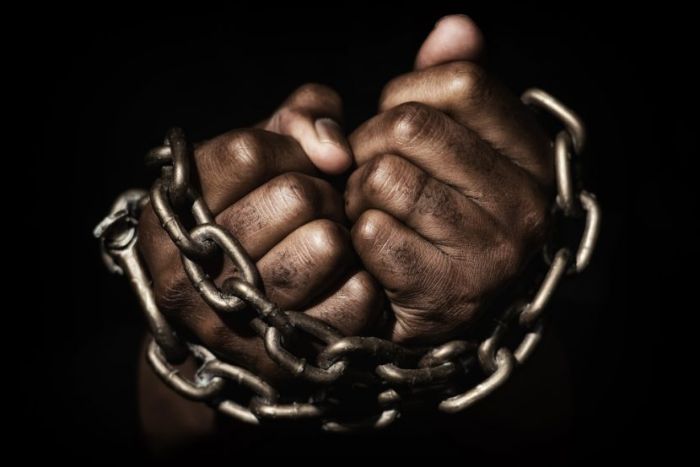
In a historical event, the United Nations General Assembly approved this Wednesday a resolution that qualifies the transatlantic slave trade and the racialized slavery of Africans as “the most serious crime against humanity” of history.
The resolution was made within the framework of the commemoration of the International Day of Remembrance for the Victims of Slavery and the Transatlantic Slave Trade which is celebrated every 25 March to honor those who suffered the brutal colonial system.
The motion received 123 votes in favor, 3 against -Argentina, Israel and the United States- and 52 abstentions, among them those of practically all the countries of the so-called Western bloc, including Japan.
He, presented by a coalition of 60 African countries, Caribbean and Latin Americans, recognizes that this exploitation system, which lasted for more than four centuries, constitutes a violation of international law that does not prescribe and that its consequences continue to affect millions of people around the world.
The resolution, which coincides with the 252nd anniversary of the Durban Declaration and Program of Action, states that the trade in enslaved Africans and the racialized slavery of Africans represent “the most inhuman and lasting injustice against humanity” due to “its magnitude, duration, systemic nature, brutality and lasting consequences that continue to structure the lives of all people through racialized regimes of work, property and capital”.
A crime without historical precedents
The text emphasizes that the establishment of this system had no historical precedents, by being “the first world regime that codified humans and their descendants as hereditary property, alienable and perpetual”, that converted “human reproduction in a mechanism of capital accumulation” and institutionalized “racial hierarchy as a guiding principle of the international political and economic order”.
The resolution recalls the legal instruments that legitimized this atrocity: from papal bulls 1452 and 1455 that authorized the reduction of Africans to “perpetual slavery”, until the Barbados Slave Code 1661 and the French Black Code 1685, that legally defined enslaved Africans as “personal property”.
It also mentions the legal principle of birth follows the womb (“what is born follows the womb”), adopted in Virginia in 1662, which established that the condition of slave was inherited biologically through African mothers.
View this publication in Instagram
Imprescriptibility and right to repair
At a key point, The General Assembly reaffirms that “crimes related to the trafficking of enslaved Africans and the racialized slavery of Africans are not subject to prescription”, in line with a fundamental principle present in all African legal and moral traditions: “crimes do not prescribe”.
The resolution emphasizes that States are responsible for internationally wrongful acts and have the obligation to fully repair the damage caused.
Thus, calls on Member States to undertake “an inclusive and good faith dialogue on restorative justice“, that includes:
-a full and formal apology.
-restitution measures, compensation, rehabilitation and satisfaction.
-guarantees of non-repetition.
-modifications of laws, programs and services to combat racism and systemic discrimination.
The role of women and the fight for memory
The text recognizes the “exceptionally gendered character” of the slave trade, what systematically subjected African women and girls to “sexual violence, forced reproduction, Domestic servitude and gender-specific forms of exploitation“.
Denounces the application of the principle birth follows the womb as a mechanism that violated their reproductive rights and subjected them “to forced reproduction to generate slave labor”.
The resolution also highlights the active resistance of Africans and people of African descent from the beginning, mentioning “the African abolitionist tradition dating back more than six centuries”, the first acts of resistance, state diplomacy, armed struggles and the strategic recourse to the courts to vindicate human rights and dignity.
Concrete measures
The General Assembly requested the Secretary General to strengthen coordination on commemoration, education and research on slavery and its aftermath.
He also urged Member States to promote comprehensive educational programs, historical memory preservation initiatives and academic research, as well as to support reparation initiatives promoted by the African Union and the Caribbean Community.
In a concrete gesture of reach, the resolution calls “immediate restitution, without obstacles and without any cost of cultural goods, art objects, monuments, museum pieces, artifacts, manuscripts and documents, as well as national archives that have spiritual value, historical and cultural” for countries of origin.
The approval of this resolution occurs in the context of the Second International Decade of People of African Descent (2025-2034) and a few months from centenary of the Convention for the Suppression of the Slave Trade and Slavery (1926).
View this publication in Instagram
